
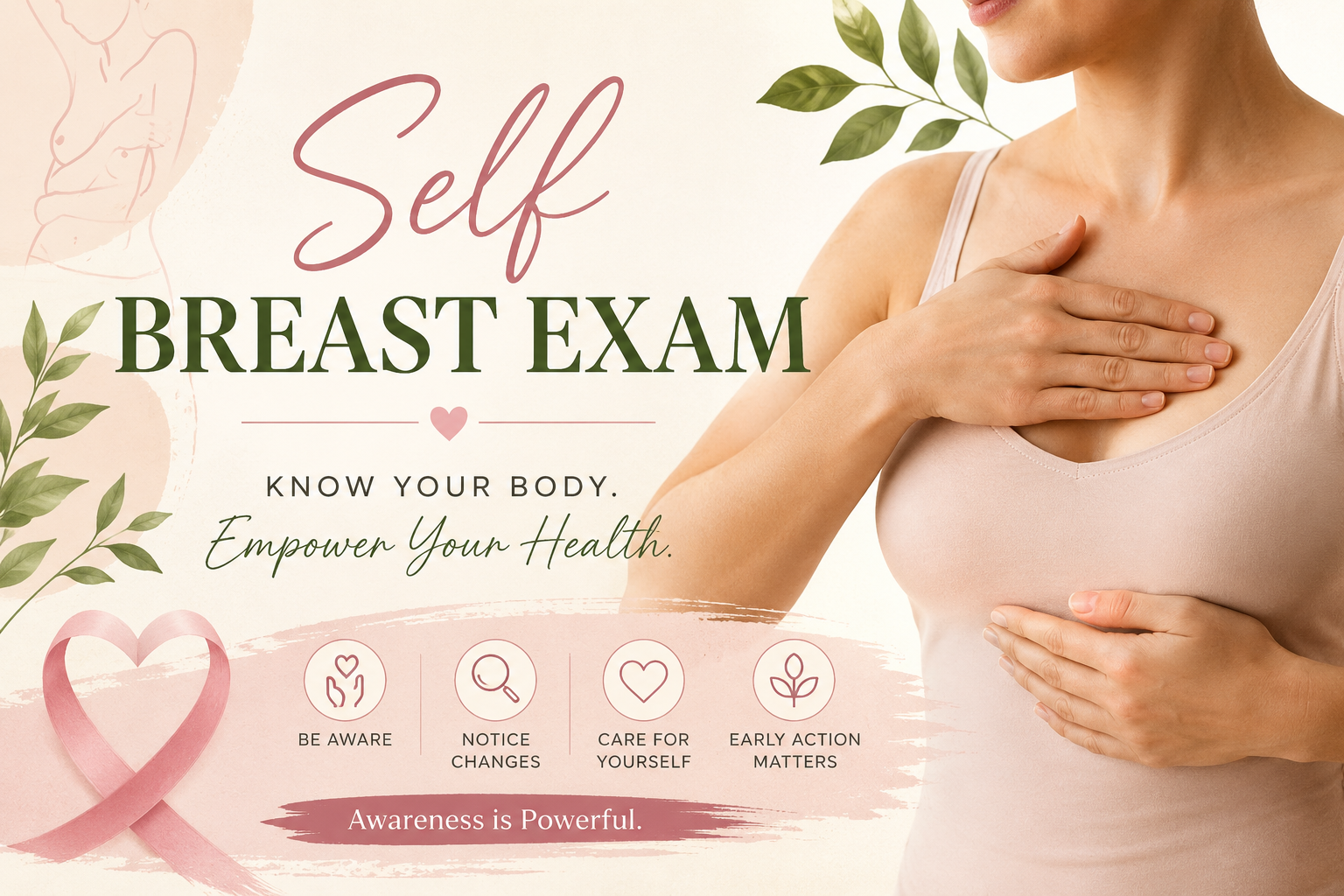
A Simple Guide to Becoming Familiar With Your Breasts
The purpose of a self-breast exam is not to diagnose disease. It is an opportunity to become familiar with your own unique breast tissue so you can recognize changes and seek appropriate evaluation when needed.
Your breasts naturally change throughout your life due to age, hormones, menstrual cycles, pregnancy, breastfeeding, and menopause. Learning what is normal for your body is one of the most valuable tools you have.
When Should I Perform a Self Breast Exam?
If you are still menstruating:
Perform your exam 5–7 days after your period begins, when breast tissue is usually less swollen and tender.
If you no longer menstruate:
Choose the same day each month (for example, the 1st day of every month).
How often?
Once a month is generally recommended.
Remember: The goal is awareness, not perfection.
Step 1: Look in the Mirror
Stand in front of a mirror with your shoulders straight and arms relaxed at your sides.
Observe both breasts and look for:
✅ Changes in size or shape
✅ New asymmetry
✅ Skin dimpling or puckering
✅ Redness or swelling
✅ Thickened skin
✅ Changes in nipple position
✅ New nipple inversion
✅ Unusual rash or irritation
Now raise your arms overhead and look again.
Finally, place your hands on your hips and gently press to engage your chest muscles while observing for any changes.
Step 2: Examine While Lying Down
When lying down, breast tissue spreads more evenly over the chest wall.
Use the pads of your three middle fingers.
Move in one of these patterns:
⭕ Circular pattern
⬆️ Vertical strip pattern (up and down)
🍰 Wedge pattern (from the nipple outward)
Use three levels of pressure:
- Light: Just beneath the skin
- Medium: Mid-level tissue
- Firm: Down to the chest wall
Cover the entire area:
- Collarbone to bra line
- Sternum to armpit
Don’t forget the tissue extending into the armpit.
Step 3: Examine in the Shower
Soap and water can make it easier to feel subtle changes.
Repeat the same pattern while standing.
Some women find it easier to detect changes during a shower.
What Different Types of Breast Tissue May Feel Like
🌸 Normal Breast Tissue
Normal breast tissue often feels:
- Soft
- Slightly lumpy
- Grainy
- Uneven in texture
- Different from one area to another
Many healthy breasts are naturally not perfectly symmetrical.
🌿 Fibrocystic Breast Tissue
Fibrocystic changes are very common.
They may feel:
- Rope-like
- Rubbery
- Thickened
- Mobile under the skin
- Tender or painful
You may notice:
- Increased tenderness before your menstrual cycle
- Areas that fluctuate in size
- Changes that improve after your period
Fibrocystic changes often occur in both breasts.
💧 Breast Cysts
Breast cysts are fluid-filled sacs.
They may feel:
- Smooth
- Round or oval
- Soft or firm
- Movable
Some cysts may be tender.
They can vary in size and often change with hormones.
⚠️ Areas That Need Medical Evaluation
Some concerning changes may feel:
- Hard or firm
- Irregular in shape
- Fixed in place
- Different from surrounding tissue
- Persistent over time
A lump that does not go away should always be evaluated.
Remember:
Cancerous breast lumps are not always painful.
Likewise:
Pain alone does not usually indicate cancer.
Contact Your Healthcare Provider If You Notice:
⚠️ A new lump
⚠️ A lump that persists after one menstrual cycle
⚠️ Skin dimpling or an “orange peel” appearance
⚠️ New nipple inversion
⚠️ Bloody or spontaneous nipple discharge
⚠️ Redness or unexplained swelling
⚠️ A persistent area of fullness or thickening
⚠️ Swollen lymph nodes under the arm or near the collarbone
A Helpful Reminder
A self-breast exam is not a screening test and cannot diagnose breast cancer.
It is one piece of your overall breast wellness routine.
Self-awareness works best when combined with regular discussions with your healthcare provider and appropriate screening recommendations based on your age, personal history, family history, and individual risk factors.
Breast Wellness Is About Awareness, Not Fear
Your body is constantly communicating with you.
The goal is not to become anxious or hypervigilant, but to become familiar, confident, and empowered.
The more familiar you become with your own normal breast tissue, the easier it is to recognize when something has changed.
Know your body. Notice changes. Seek guidance when needed.
Important Disclaimer
This handout is intended for educational purposes only and is not intended to diagnose, treat, cure, or prevent any disease. A self-breast exam does not replace medical evaluation or recommended breast screening. Always consult your healthcare provider regarding new or concerning findings.